
How to build a Canadian-style resume

A Canadian-style resume should be clear, concise, and results-focused. Keep it to 1–2 pages, with a clean format, professional font, and no photos or personal details. The most common format is reverse-chronological, which lists your work experience starting with the most recent job. Newcomers or career changers may prefer a skills-based (functional) resume, while a combination format works well for mid- to senior-level professionals.


Start with a header that includes your name, phone, professional email, city/province, and optionally LinkedIn. Avoid personal info like age, photo, or marital status. Add a short professional summary (2–4 sentences) highlighting your experience, skills, and value to the employer. Include a skills section with 6–12 relevant abilities, such as software, technical, or soft skills.


Next, list professional experience with job title, company, location, dates, and 3–5 bullet points that focus on achievements rather than duties. Education comes next, including your degree, school, location, and graduation year. Add certifications or other relevant sections like volunteer experience, languages, or awards if applicable.


Ensure your resume is tailored to each job, using keywords from the posting and highlighting measurable achievements. Keep formatting consistent, use Canadian spelling, and proofread carefully. Following this approach will make your resume professional, Canadian-style, and attractive to employers.


Resume Sample:

[Full Name]
[City, Province] | [Phone Number] | [Professional Email] | [LinkedIn Profile]


Professional Summary:


A brief 2–4 sentence overview of your experience, skills, and value. Example: Detail-oriented Accounting Professional with 5+ years of experience in financial reporting and budgeting. Skilled in QuickBooks, Excel, and payroll processing. Proven ability to streamline processes and improve accuracy.


Key Skills:

  • Skill 1 (e.g., Customer Service)
  • Skill 2 (e.g., MS Office)
  • Skill 3 (e.g., Project Coordination)
  • Skill 4 (e.g., QuickBooks)
  • Skill 5 (optional)
  • Skill 6 (optional)


Professional Experience:


Job Title – Company Name | City, Province
Month/Year – Month/Year

  • Achievement-based bullet point (use numbers if possible)
  • Achievement-based bullet point
  • Achievement-based bullet point

Job Title – Company Name | City, Province
Month/Year – Month/Year

  • Achievement-based bullet point
  • Achievement-based bullet point
  • Achievement-based bullet point


Education:

Degree/Diploma – School Name | City, Province | Graduation Year


Certifications (Optional):

  • Certification Name – Issuing Organization | Year


Additional Sections (Optional)

  • Volunteer Experience
  • Languages
  • Awards
  • Projects

Tips:

  1. Keep it 1–2 pages.
  2. Use clean fonts (Arial, Calibri, Helvetica, 10–12 pt).
  3. Avoid photos, age, or marital status.
  4. Tailor each resume to the job posting with keywords.
  5. Highlight achievements with numbers wherever possible.
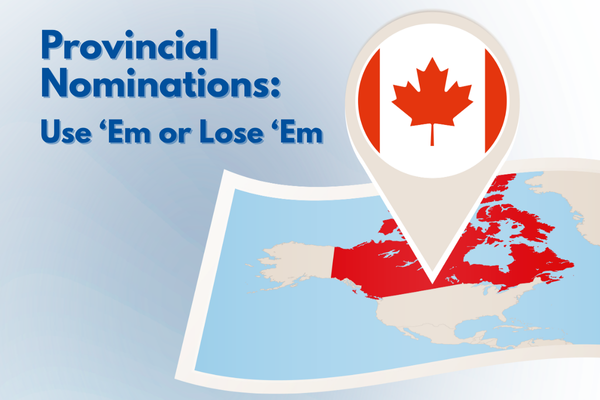

By Dirk Propp November 17, 2025
As provinces work to use up their remaining 2025 nominations and travel-based permit applications gain popularity, it’s never been more important to plan ahead, both for employers and workers.  Provincial Nominations Have Returned Provinces across Canada have received some of their unused nominations back, meaning more opportunities for both employers and applicants. We encourage you to check each province’s immigration website for updates as they begin issuing these newly available spots. From experience, government programs operate on a “use it or lose it” basis. Provinces that don’t use their full nomination allotment may receive fewer in future years. With the end of the year approaching and a potential reset of nomination quotas, most provinces will be working to allocate every remaining nomination before 2026. In Saskatchewan, where the program previously closed after reaching capacity, the province is now creating a list of employers and contacting them to confirm whether positions are still needed. This allows them to issue Job Approval Letters (JALs) and proceed with nominations. If you’re an employer in Saskatchewan who hasn’t yet joined the queue, now is the time to get your name on that list. Holiday Work Permit Applications to Work in Canada Holiday Port of Entry Applications are a new and growing trend, and I believe we’ll see a steady increase in these for those who qualify. Traditionally, people would go to the nearest land border to obtain a new work permit based on their LMIA, nomination, PR in process or an applicable exemption. However, beginning in 2025, land borders will no longer be able to issue work permits, which makes Holiday Port of Entry applications a new and viable option. It’s important to note that people previously had the opportunity to apply for work permits from within Canada, so this wasn’t a problem. That option has also been removed, further reinforcing the relevance of Holiday Port of Entry applications for work permits. If you're from a country not listed below, you’ll need to apply for a new work permit and cannot use a Port of Entry to obtain a decision without submitting an application. In that case, your options are to apply from your country of citizenship or from a country where you are legally permitted to be and currently present. This introduces the concept of the Holiday Application, many destinations now have quick work permit processing times. By applying online after you land, you can enjoy a short warm (or cold) holiday while waiting for a decision on your new work permit. Individuals from the countries listed below are able to apply for a work permit upon entry, based on holding an eTA. There are two main groups to consider: Visa-exempt countries that can always apply upon entry, and2. Conditionally visa-exempt countries, where eligibility depends on the applicant having held a Canadian visa within the past 10 years or currently holding a valid U.S. non-immigrant visa. In my opinion, it would be wise to stay at least a day or two as part of your holiday so that it’s not blatantly obvious that you are “Holiday Flag Poling.” Take the opportunity to genuinely enjoy a short holiday before obtaining your work permit to return to Canada. For individuals who are not from a visa-exempt country, check which countries you are legally permitted to travel to and how long you can stay there. Then, review how long it takes to obtain a work permit from that location if you’d prefer not to return to your home country to apply. For employers: If you have a worker whose status has expired or who has gone out of status, and that worker entered under a Dual Intent LMIA, you are not required to pay for the flight home or to another country they choose (as long as both parties agree). For Low-Wage LMIA applications, however, it’s important that employers do pay for the return flight, so speak with your employee or applicant in advance to confirm costs and ensure this is arranged. Lastly, applying for a work permit while traveling does not guarantee approval. A strong and professionally prepared application is always recommended. Ultimately, the immigration officer has the discretion to make the final decision. So feel free to reach out to the team at Fill a Role before hand to get assistance and a second-opinion.
By Dirk Propp October 2, 2025
Refuse to process regions in Canada are affecting nearly all metropolitan areas in Canada, and more regional changes were announced on October 10th. The regions that are still available to keep your trained and employed foreign workers or obtain new if local people are not available are: BC - Victoria Saskatchewan - Saskatoon Ontario - Thunder Bay New: Peterborough Quebec - Drummondville, Trois-Rivieres, Sherbrooke, Quebec, Saguenay PEI - Entire province The following regions, before October 10th, qualified and no longer qualify to keep their foreign workers in low-wage positions: BC - Kelowna Alberta - Red Deer, Lethbridge Saskatchewan - Regina Manitoba - Winnipeg Ontario - Sudbury, Guelph All other metropolitan cities in Canada do not qualify to keep their foreign workers in low-wage positions. The other occupations businesses qualify to keep their workers are: Rural communities outside of the metropolitan areas. Health care workers Care home workers Construction workers Food Manufacturing Seasonal businesses requiring workers for 120 or 270 days or less Simplify Hiring, Stay Compliant Canada’s hiring landscape is shifting quickly, with refuse-to-process regions expanding, new unemployment data set to be released in October, and employers under pressure to act fast. Fill a Role was built to give you an advantage. If you’re an employer, this means fewer wasted hours and faster hires. If you’re a job seeker, it means your application rises to the top where employers can see it. Don’t wait until the next round of immigration changes catches you off guard. Start posting with Fill a Role today.